
| Company information | Details |
|---|---|
| Company | Magentic |
| What it does | Builds AI digital workers for procurement and supply-chain teams |
| Product | AI digital workers called Mages |
| Primary users | Large manufacturers, procurement teams and supply-chain organisations |
| Core capabilities | Procurement analysis, supplier selection, contract analysis, purchasing, order management, invoice reconciliation and savings recovery |
| Industries | Industrial & manufacturing, consumer goods and other large enterprises |
| Funding announced | $18 million Series A |
| Lead investor | Felicis |
| Other investors mentioned | Sequoia Capital and The Westly Group |
| Founded by | Robin Van Aeken, CEO, and Odhran O’Donoghue, CTO |
| Launch | July 2025 |
| Locations | London and New York |
| Website | Magentic.com |
Magentic Raises $18 Million to Expand Its AI Workforce for Industrial Companies
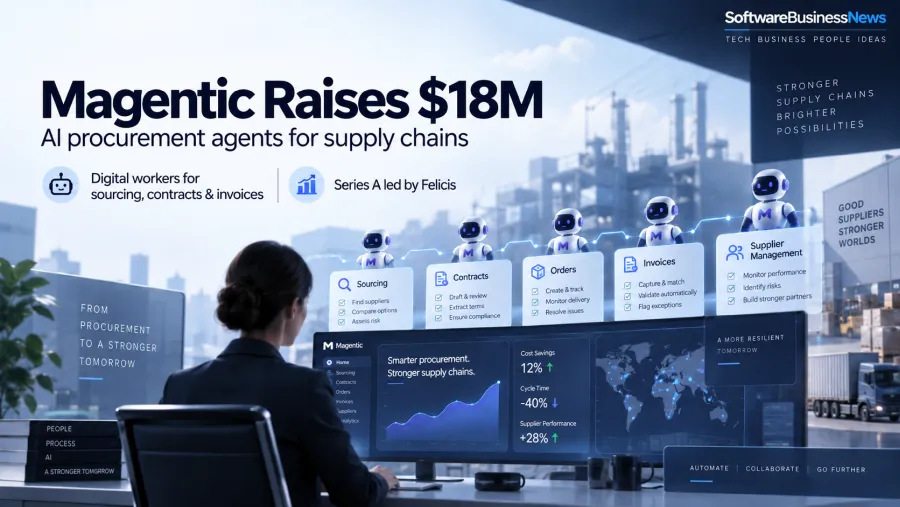
AI procurement startup Magentic has raised $18 million in Series A funding as it looks to expand its AI digital workers across procurement and supply-chain operations at large industrial companies.
The London- and New York-based company announced the funding on September 17, 2026. The round was led by Felicis, with participation from existing investors Sequoia Capital and The Westly Group.
Magentic says the new investment will be used to accelerate development of its AI agents, expand coverage across procurement and supply-chain workflows, and support longer-term AI research for complex optimisation problems.
What Does Magentic Do?
Magentic develops AI agents designed to perform operational procurement and supply-chain work inside the systems companies already use.
The company refers to these AI digital workers as “Mages.”
Rather than functioning only as software that presents information through dashboards, Magentic says its digital workers are designed to take action on behalf of procurement teams while keeping people in control.
The agents can work through channels such as Microsoft Teams, email and internal enterprise systems.
Magentic positions the technology as an AI operating layer for procurement, sitting on top of existing enterprise tools rather than requiring companies to replace their current systems.
What Can Magentic’s AI Workers Do?
Magentic’s technology covers several stages of the procurement process.
Its AI agents can review spending, analyse contracts, compare suppliers, identify better purchasing terms and help execute purchasing workflows.
According to Magentic, its digital workers can also determine whether an organisation should buy or build something, help select suppliers, support contract negotiations, process orders and resolve invoices.
The platform is designed to work with information coming from multiple sources, including:
- Enterprise resource planning systems
- Supplier contracts
- Invoices
- Spreadsheets
- PDFs
Magentic says its AI can convert fragmented procurement information into structured data that its agents can analyse and act upon.
Finding Procurement Savings
A major part of Magentic’s product strategy is identifying areas where companies are spending more than necessary.
For example, the system can analyse previous purchase orders and invoices to identify overpayments, missed rebates and purchases made outside agreed contract terms.
Magentic can then build the supporting evidence needed for procurement teams to recover that money from suppliers.
Its AI agents can also identify situations where equivalent products could potentially be purchased at a lower price and calculate the potential savings associated with switching suppliers or products.
Another use case involves preventing unnecessary costs before a purchase happens.
Magentic can check purchases against approved suppliers and negotiated pricing and identify transactions that appear to be moving outside existing contracts.
Reading and Monitoring Supplier Contracts
Supplier agreements can contain thousands of individual pricing conditions, obligations and other commercial terms.
Magentic says its digital workers can analyse supplier contracts and extract information including pricing terms, contractual obligations and liability conditions.
The system can then compare those contract terms against actual purchase orders and invoices. This allows procurement teams to identify price discrepancies or situations where negotiated terms have not been followed.
Invoice Matching and Reconciliation
Magentic’s AI agents can also work with invoices, purchase orders and goods receipts.
The company says its agents can extract invoice information and compare it with purchase orders and other records.
Small discrepancies may be resolved automatically, while larger issues can be sent to employees with the relevant context already prepared for review.
The system can also validate supplier information such as tax IDs, bank details, addresses and certifications against company requirements and external information.
Supporting Both Direct and Indirect Procurement
Magentic says its technology can work across both direct and indirect spending.
Indirect procurement includes purchases such as office equipment, IT hardware and maintenance-related supplies.
Direct procurement includes materials that become part of the company’s finished products.
For manufacturers, Magentic says its technology is being used across categories including packaging, raw materials, office equipment, IT hardware and maintenance, repair and operations spending.
Designed for Large Manufacturers
Magentic is primarily targeting large enterprises and global manufacturers.
The company says its technology has to work with environments containing billions of data rows, large purchasing budgets and older enterprise systems that may still rely heavily on spreadsheets and customised ERP software.
One customer processes more than one million orders per year through Magentic’s AI agents, according to the company.
Magentic also says another customer has identified approximately $4 million in savings using the platform.
Across its Global 500 customer base, the company reports typical savings of 2% to 5%, along with an average 60% improvement in data quality. Magentic’s website also states that its digital workers have processed 1.2 million orders for one customer. )
These figures are company-reported performance metrics rather than independently verified results.
AI That Works Inside Existing Enterprise Systems
Magentic’s approach reflects a broader shift in enterprise AI from software that simply generates answers toward AI systems capable of carrying out workflows.
The company describes its technology as a multi-agent system in which multiple specialised AI agents can work together to complete a task.
Magentic says the technology can analyse problems, plan actions and continue executing a workflow rather than stopping after producing a recommendation.
The company’s procurement platform includes several technology layers:
Data ingestion gathers information from fragmented enterprise sources.
A harmonised data layer connects information across those systems.
An agentic engine coordinates AI agents.
Procurement-specific knowledge provides context for those agents.
Real-time monitoring allows them to detect new issues.
End-to-end execution enables the system to take actions based on its findings.
Enterprise Security and Deployment
Allowing AI agents to operate inside procurement and financial systems creates additional security requirements.
Magentic says its platform supports zero-data-retention agreements with major AI providers and can be deployed across different cloud environments and data regions.
The company also states that it is ISO 27001 certified, meets SOC 2 requirements, operates under GDPR and aligns its AI systems with requirements of the EU AI Act..
Founded by Robin Van Aeken and Odhran O’Donoghue
Magentic was founded by Robin Van Aeken, who serves as CEO, and Odhran O’Donoghue, the company’s CTO.
The company says its founding team includes people with backgrounds at McKinsey and OpenAI.
Magentic officially launched in July 2025 and operates from London and New York.
Before the latest Series A, the company announced a $5.5 million funding round in July 2025 from Sequoia Capital, First Momentum and Westly Group.
Expanding From Procurement Agents to an AI Workforce
Magentic’s latest funding suggests the company is looking beyond individual procurement automation tools toward a broader system of AI workers handling operational tasks.
The company’s goal is for one digital worker handling a particular process to eventually become part of a larger AI workforce operating across procurement and supply-chain functions.
For large manufacturers, the attraction is potentially significant.
Procurement teams often work across large numbers of suppliers, contracts, invoices, purchase orders and legacy enterprise systems. Magentic is attempting to automate much of the research, reconciliation and repetitive operational work involved in those processes while allowing human teams to remain responsible for strategic decisions and supplier relationships.
With its new $18 million Series A, Magentic plans to expand the range of work its AI agents can perform and deepen the technology behind its digital workforce for global manufacturers.
Official sources
- Magentic — $18M Series A announcement
- Magentic — Official website
- Magentic — Capabilities
- Magentic — Use cases
- Magentic — Industries
- Magentic — Introduction to digital workers in procurement
- Magentic — Earlier $5.5M funding announcement
Venkat