
Artificial intelligence has become increasingly capable of generating text, images and software code. London-based startup Mantic is working on a different AI challenge: predicting what is likely to happen in the future.
Founded in London in 2024, Mantic says its mission is to solve what it calls judgmental forecasting and use more accurate predictions to improve decision-making.
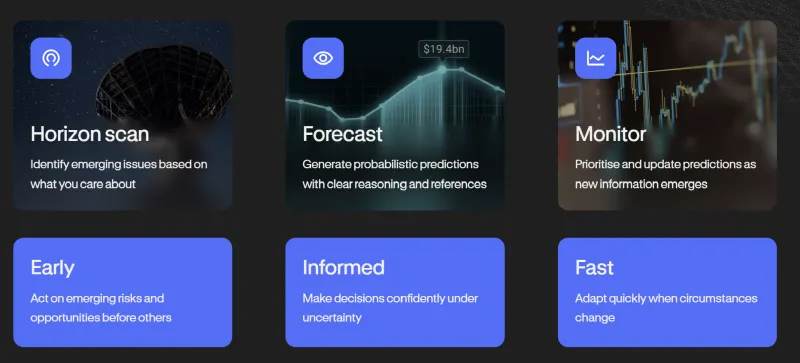
What Mantic Does?
Mantic develops AI systems designed to predict events in areas where simple historical-data models may not be enough.
The company highlights fields including:
- Business
- Geopolitics
- Public policy
- Technology
- Culture
These are areas where outcomes can depend on rapidly changing information, human behaviour and multiple interacting factors.
According to Mantic, these kinds of forecasts require both research and contextual reasoning rather than simply extrapolating historical data.
Building an AI Superforecaster
Mantic’s broader ambition is to create what it describes as a general AI superforecaster.
Instead of simply answering questions about current events, the technology is intended to assign probabilities to possible future outcomes.
The company says its forecasting system can continuously monitor developments and update predictions as circumstances change.
For example, during the Iran crisis, Mantic used its system to generate and update forecasts related to military developments, energy markets, shipping and wider macroeconomic consequences.
Mantic says the system can automatically identify new forecasting questions as events develop.
Why Forecasting Is Difficult for AI?
Mantic argues that forecasting is fundamentally different from many of the tasks at which modern AI systems already perform well.
Recognising an object in an image or translating text largely involves interpreting information that already exists.
Predicting the future requires understanding how numerous factors might interact.
Markets can react to economic data, company decisions, political developments and human expectations. Supply chains can be affected by regulation, weather and geopolitical events.
Mantic therefore sees real-world prediction as a challenging frontier for artificial intelligence.
Training AI Specifically for Forecasting
Mantic is also conducting research into whether AI models can be trained specifically to become better forecasters.
In research published in July 2026, the company said it fine-tuned the gpt-oss-120b model using reinforcement learning on approximately 10,000 binary forecasting questions.
The model was rewarded according to the probabilities it assigned to outcomes that eventually occurred.
Mantic reported that this specialised training improved the model’s performance on held-out forecasting questions from the Metaculus AI Benchmark.
The research was presented at the ICML 2026 Workshop on Forecasting as a New Frontier of Intelligence.
Combining Multiple AI Models
Another area Mantic is researching is whether combining forecasts from different AI models can produce better predictions.
In separate research published in July 2026, Mantic examined forecasts produced by multiple frontier AI models.
The company found that simply generating more forecasts from similar models provided limited additional benefit when those models tended to make similar mistakes.
Instead, its research suggested that combining accurate models whose predictions differ from one another can strengthen an AI forecasting system.
AI Forecasting for Real-World Decisions
The potential applications for this type of technology extend beyond forecasting competitions.
Companies constantly make decisions based on uncertain future events.
Executives may need to estimate where markets are heading, whether technologies will be widely adopted, how regulations may change or whether geopolitical events could affect their businesses.
Governments, investors and researchers face similar problems.
Mantic’s proposition is that AI could eventually help organisations make these decisions by providing continuously updated probability estimates rather than relying solely on individual judgement.
Mantic’s Team
Mantic was founded by Ben Day and Toby Shevlane.
Day serves as the company’s CTO. Before founding Mantic, he was Head of Research at Foresight Data Machines and worked on artificial intelligence used to optimise steel production.
He holds a PhD in machine learning from the University of Cambridge, where his research included meta-learning and graph neural networks.
Mantic says its technical team includes people with experience from organisations including Google DeepMind, Citadel and the universities of Cambridge and Oxford.
A Different Direction for Enterprise AI
Much of the current AI software market focuses on helping people produce information faster.
Mantic is pursuing a different question: Can artificial intelligence help organisations make better decisions about events that have not happened yet?
If AI forecasting continues to improve, software that calculates and continuously updates probabilities could become another category of decision-support technology for companies, governments and financial institutions.
Mantic is working toward that future by combining AI reasoning, automated research and specialised forecasting models to predict an uncertain world.
Venkat